



Why raising your cloud quota rarely fixes the bottleneck you think it fixes — and what actually does.
That question came up twice in one week, in two completely unrelated fields, and both times it turned out to be the same question.
One was with a computational protein design team. Their wet lab screening capacity had just scaled 50x, and their compute request was simple: raise our AWS Spot GPU quota so more of the workload can run on cheaper capacity. The other was with a fusion energy research team running GPU-accelerated plasma simulations — usage swinging from zero to dozens of GPUs and back, locked into a fixed, all-upfront contract sized for their busiest week.
Different science. Different hardware. Same underlying issue: neither team had a compute shortage. They had three problems wearing a compute shortage’s clothes.
Problem 1: The Number You’re Asking For Isn’t the Real Constraint
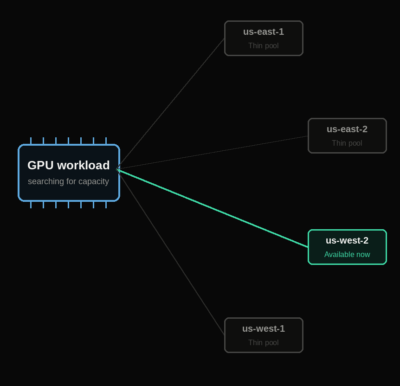
Raising a Spot quota raises a ceiling. It doesn’t create more capacity in a specific AWS region at a specific hour. The protein design team could hold a much larger quota and still stall out if that region’s Spot pool happened to be thin that day — and when a design-build-test cycle has to keep pace with a 50x jump in wet lab throughput, stalling isn’t a rounding error. It’s the entire bottleneck, just moved one layer down the stack.
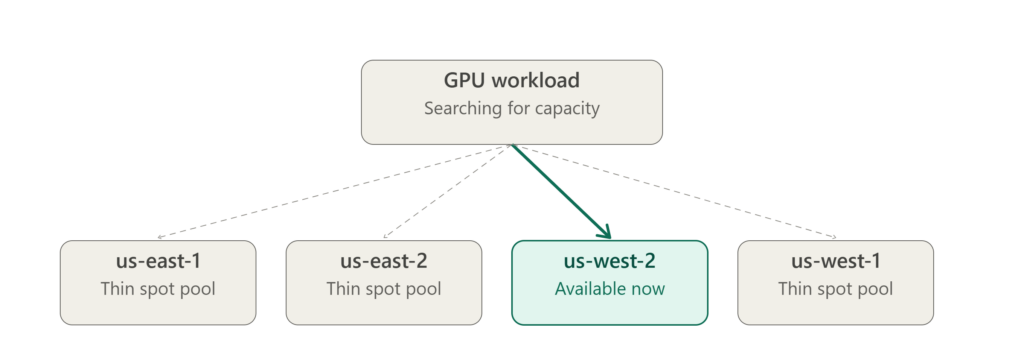
The real lever is federation, not ceiling. Every AWS region runs its own Spot pool, moving independently, minute to minute. A workload that can search across all of them — trying the best available strategy in one region and automatically failing over to the next — gets access to many regions’ worth of capacity instead of gambling on a single one. That’s the difference between a campaign finishing in a day versus a week, and it has almost nothing to do with the size of the quota.
Problem 2: Cost-vs-Availability Is a Full-Time Job Nobody’s Been Hired For
Neither team had a person whose actual job was “figure out the cheapest available GPU configuration right now, for this specific job.” That’s not a staffing gap — it’s a structural one. AWS offers more than 770 instance types, with roughly 160 new ones added in 2025 alone. Availability and pricing shift by the minute. No domain scientist should be expected to track that space by hand on top of running actual experiments, but somebody has to answer that question continuously, or the gap between what’s running and what’s optimal compounds with every campaign.
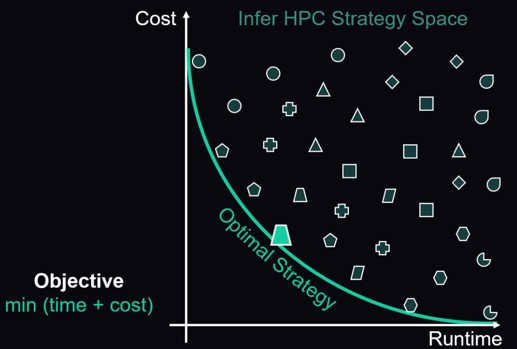
This is also where an unexamined default quietly costs the most. The fusion energy team had been running the same GPU configuration for every simulation — not because it had been measured against alternatives, but because it was what they’d always used. A few concrete questions (Does the workload tolerate mixed precision? Are the parallel runs independent or tightly coupled?) changed both the right hardware choice and the achievable scale. None of that required guessing. It required benchmarking.
Problem 3: Time-to-Insight Gets Lost Upstream of the Science
In both cases, the real bottleneck sat before the science ever started: quota approvals, contract cycles, instance selection, data staging. Both teams were ready to run. Infrastructure was what stood between them and results.
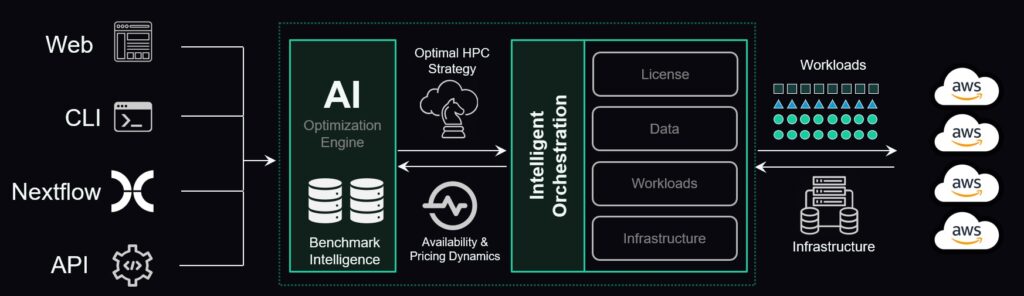
The fix looks less like negotiating a bigger contract and more like removing the negotiation entirely. A workload should launch with a single command, get benchmarked automatically, and run on whatever combination of region, instance type, and pricing model is actually optimal for it right now — without a human re-deriving that answer every time hardware or pricing shifts underneath them.
What This Looks Like When It’s Solved
None of this is theoretical.
Chemspace, a discovery services provider running GROMACS compound screening, cut a workflow that used to take 4 weeks and $5,500 down to 6 hours and $750. That’s not a marginal tuning gain — it’s the difference between a screening result landing this afternoon versus a month from now. And it came from the same principle behind both conversations above: someone measured the strategy instead of assuming the one they’d always used was still correct.
Beren, a biotech startup, saw something similar on its AI-accelerated docking pipeline: a cycle that used to take 48 hours now takes 30 minutes.
Xenon, a biopharmaceutical company, had been running Schrödinger FEP+ simulations for 12 days at a stretch, while using only a quarter of the software licenses they were already paying for. Once the GPU strategy was actually optimized, the same simulations finished in 12 hours — using the full license capacity they’d had all along. That last detail is the one I find most telling: the fix wasn’t more compute or more licenses. It was using what they already owned, properly.
And this isn’t limited to biotech. Komatsu, the heavy equipment manufacturer, saw a 30% lift in innovation productivity after moving its HPC workloads from fixed infrastructure to a continuously benchmarked strategy.
Different industries. Different software. Different hardware. Same underlying move each time: someone stopped assuming the current setup was optimal and started measuring it.
The Actual Fix
That’s what Fovus is built to do: benchmark the actual workload, determine the optimal strategy across compute, storage, and licensing, and run it efficiently on AWS by default — so the people doing the science don’t have to become cloud infrastructure specialists to get their results.
If your team’s compute story sounds like either of the two I started with, the fix probably isn’t a bigger number. It’s asking what’s actually happening underneath the one you have.
FAQ
- Does raising an AWS Spot GPU quota guarantee more compute capacity?
No. A quota is a ceiling on what you’re allowed to use, not a guarantee of what’s available. Actual Spot capacity varies by region and by hour, so a workload confined to one region can still stall even with a large quota. Searching across multiple regions and failing over automatically — federation — is what actually increases usable capacity.
- Why do HPC teams keep using the same GPU configuration instead of the cheapest available one?
Usually because nobody owns that question full-time. With 770+ AWS instance types and pricing/availability shifting minute to minute, matching a workload to the optimal configuration requires continuous benchmarking — not a one-time choice made when the project started.
- What’s the difference between more compute and better-orchestrated compute?
More compute means a bigger contract or quota. Better-orchestrated compute means an existing budget or license pool is matched, in real time, to the cheapest and fastest available combination of region, instance type, and pricing model — often producing dramatically faster and cheaper results without buying anything new.